Category:
Posted on March 8, 2026
Everyone's on placement. The one person you were meant to practice with hasn't replied in three days. You've got two weeks left and the thought of cold-calling a coursemate to role-play a psychiatric history feels genuinely awful. If that's where you are right now, you're not disorganised or behind. This is a structural problem at UK medical schools, where OSCE season collides with the most chaotic rotation scheduling imaginable. You can still prepare well. Here's how.
The honest reason solo practice feels pointless to most students is that OSCEs are inherently interactive. You're being assessed on communication, not just knowledge. Sitting quietly reading a mark scheme feels nothing like standing in front of a simulated patient while an examiner watches you from the corner.
But here's what most students miss: the majority of OSCE marks aren't lost because of gaps in clinical knowledge. They're lost because of hesitation at the start, forgetting to flag red flags, rushing through ICE, or closing the station awkwardly under pressure. All of that is trainable alone, if you do it the right way.
The methods below aren't filler. Each one addresses a specific failure mode. Some will feel uncomfortable. That discomfort is doing something.
Mirror practice has a bad reputation because most students do it badly. You stand in front of the mirror, start talking, and within about 15 seconds you're staring at your own face, picking apart your expressions, and have completely lost your train of thought.
The fix is simple: don't look at your own eyes. Pick a fixed point just above the mirror, a mark on the wall, a post-it note, and talk to that. You're not practising your face. You're practising fluency and flow.
Use the mirror specifically for the opening of the station: entering, introducing yourself, setting the agenda. Do that sequence ten times until it comes out automatically, regardless of what else is going on in your head.
Most students refuse to do this. The ones who do, and actually watch it back, improve faster than almost any other method.
The resistance makes sense. Watching yourself on video is genuinely uncomfortable. But that discomfort is the feedback. You'll catch things no one else would ever tell you: that you speak twice as fast as you think you do, that you drop eye contact every time you try to remember the next question, that you said "um" eleven times in a two-minute history.
When you watch it back, focus on three specific things:
Do you sound rushed? Not just fast, but rushed. There's a difference.
Did you actually ask about red flags, or did you assume you did?
Did you summarise back to the patient and check understanding?
You don't need to record every practice run. Even two or three recordings over the course of your prep will show you patterns you'd never notice otherwise.
This one sounds strange. It works.
Set up a chair opposite you. Sit down (don't stand, don't pace) because in the actual OSCE stations, you'll be seated for most history and communication stations. Set a 7-minute timer on your phone with a second alarm at the 6-minute mark as a warning.
Then talk. Say every single word out loud as if there's a patient in the chair.
The physical setup matters more than it seems. The act of sitting, facing a direction, and speaking to something, even an empty chair, recruits a different kind of attention than reading silently. Silent reading is essentially useless for OSCE prep. Your brain processes it as revision, not performance.
When the 1-minute warning alarm goes, you should be wrapping up, not still mid-history. Treat the alarm as real. If you're not at closure, skip to it. Getting caught mid-station because you didn't practice timing is one of the most avoidable ways to drop marks.
A lot of students are already doing some version of this with ChatGPT, which works better than nothing but has some real limitations: it doesn't time you, it rarely pushes back the way a real SP would, and it tends to hand over clinical information too freely.
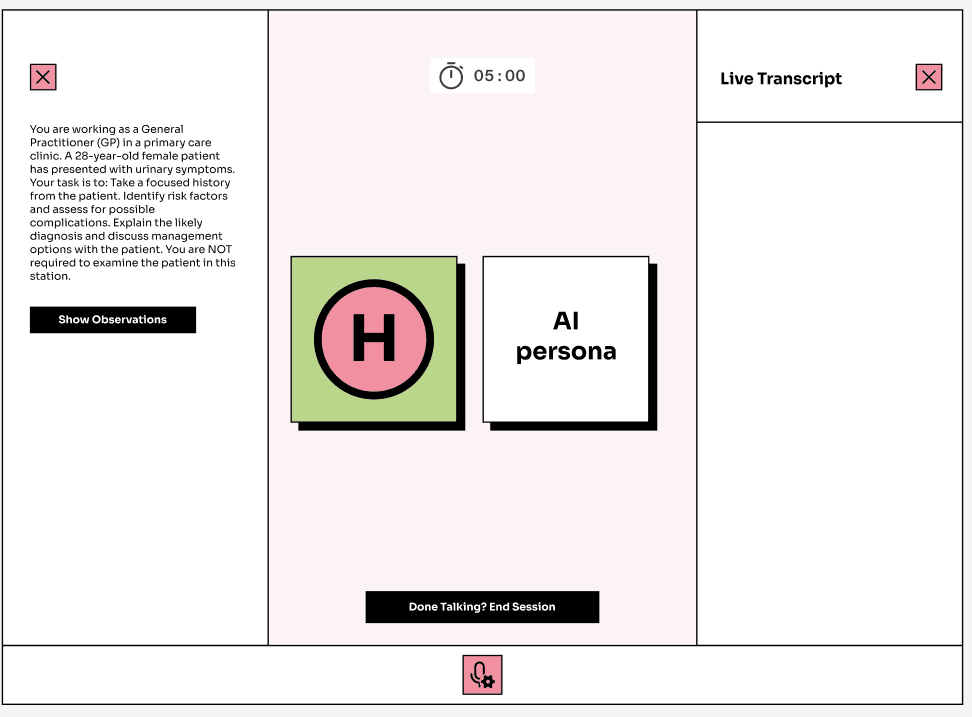
Dedicated tools built for UKMLA CPSA prep are a step up. MLAbuddy uses voice-based AI patients that respond in real time, which forces you to listen and adapt rather than just run through a checklist. The timing pressure is built in.
AI practice doesn't replace the unpredictability of a real person. No tool does. But for solo prep, especially on history stations and communication skills, it closes a lot of the gap. It's particularly useful for late-night practice sessions when no coursemate is going to respond to your message.
These exist and are more active than most students realise.
r/medicalschooluk occasionally has revision partner threads, especially in the weeks before major OSCE seasons. Most UK medical school Facebook groups have students actively looking for online OSCE partners. Some universities have Discord servers set up specifically for OSCE practice. It's worth searching your university name plus "OSCE Discord" or asking in year group chats.
Online video call practice with someone you've never met is actually less awkward than it sounds. Neither of you knows each other well enough to be embarrassed, and the structured format of OSCE stations keeps the session focused. You can take turns being patient and student, run four or five stations in an hour, and get feedback that no AI or mirror can give you.
This is the method most students skip entirely, which is a shame because it's high-value and takes almost no setup.
Take a mark scheme (from your university, Oxford Clinical Examinations, wherever you have access) and instead of reading the checklist, say each question out loud as if you're asking a real patient. Not "mental state examination: mood" but actually: "How would you describe your mood over the past few weeks?"
The verbalisation is what builds the muscle memory. Reading silently feels like revision. Saying it out loud, with some kind of pacing and flow, starts to feel like practice. Run through the mark scheme three or four times until you can get through the whole checklist without looking.
This is particularly useful for systems you're weak on, because it forces you to confront exactly which questions you'd hesitate on mid-station.
You know this already. The opening — knocking, entering, washing hands, introducing yourself with your full name and role, confirming the patient's name and date of birth — is worth marks. So is a clean closure: summarising, signposting next steps, checking understanding, thanking the patient.
These marks are lost routinely by students who know their clinical content completely. They're lost because under pressure, students skip straight to the clinical content and bolt on a limp "any questions?" at the end.
The only way to stop losing these marks is to make the opening and closing so automatic that they happen before your brain has caught up. That means practicing them every single time you sit down for any kind of solo practice — not just on dedicated runs, but as the default way you enter and exit any practice scenario.
Set a rule: every session starts with a knock and an introduction, even if you're alone in your room.
The answer depends on how far out you are.
Three or more weeks out: This is when recording yourself is highest value. You have time to actually change behaviour based on what you see. Use Method 2 regularly, combine it with mark scheme verbalisations (Method 6) for stations you're weakest on, and do at least a few runs with AI patients (Method 4) to build fluency on history taking.
One week out: At this point, you don't want to discover new problems. Prioritise Method 3 (empty chair with timer) and Method 7 (intro and closure every time). These are the highest return-per-hour activities in the final week because they address failure modes that knowledge-based revision completely ignores. Run full timed stations with the physical setup. Keep the sessions short and sharp. Five stations a day done properly beats two hours of passive reading.
The mirror and the recording are both uncomfortable. The timer is harder than it sounds. The mark scheme out loud feels slightly absurd. Do them anyway. That's the point.
Free to start. No card needed, no credits to top up.
